U-Boot x86 UEFI payload on Canoeboot
This documentation is OBSOLETE, applying onto to Canoeboot versions from December 2024 up to January 2026; the following releases from October 2026 and later use EDK2 instead of U-Boot, for UEFI on all boards. This is using our own free distribution of EDK2, designed for use with Canoeboot.
For UEFI, please look instead at ../install/edk2.html.
EDK2 is much more feature-complete and generally reliable, on all platforms.
Again, this is obsolete. Modern Canoeboot only uses U-Boot on non-x86 platforms:
U-Boot UEFI on x86
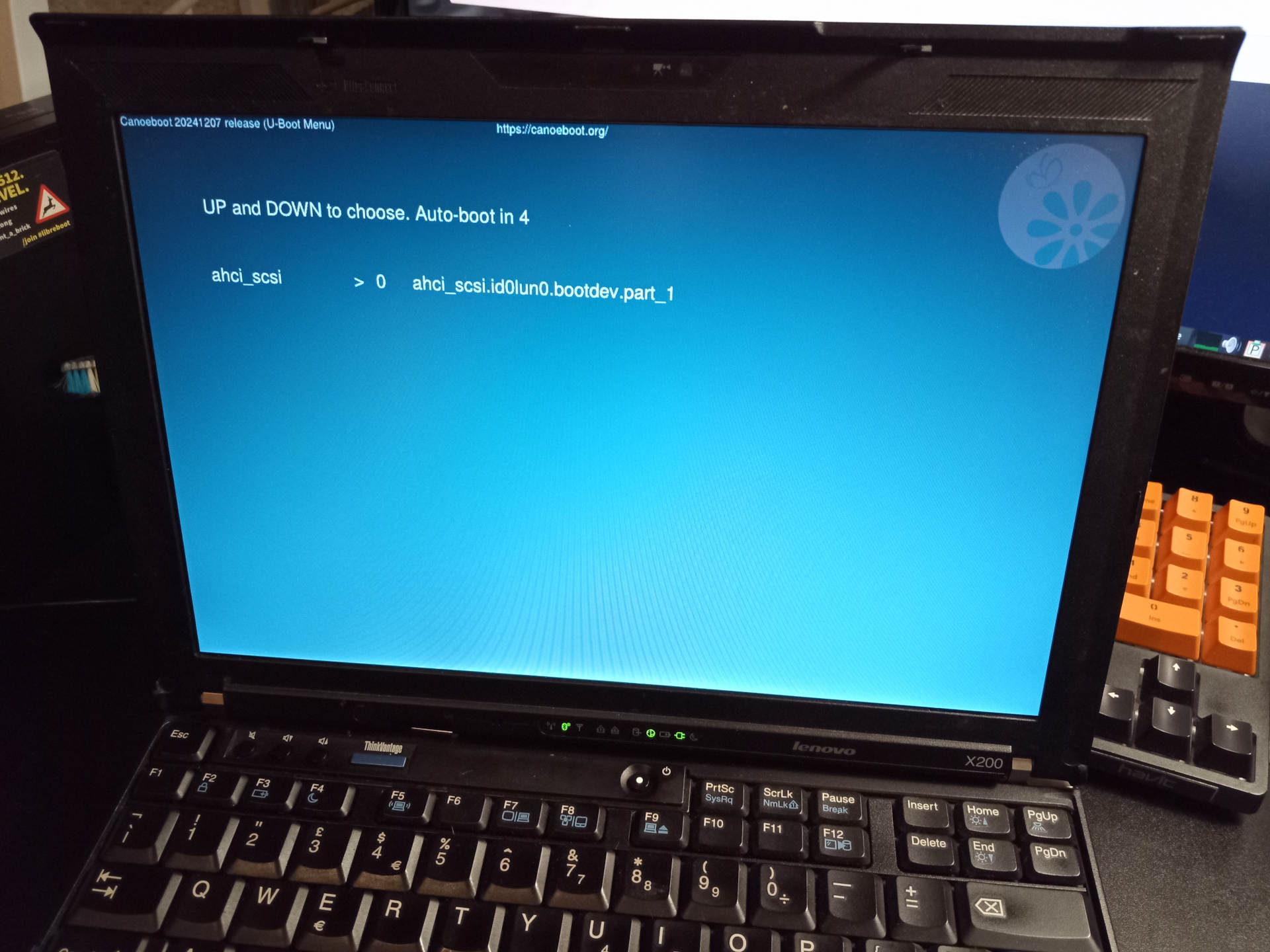
U-Boot is available as a coreboot payload, in Canoeboot 20241207 and later, on x86 boards; on ARM it has been available since Canoeboot launched.
Please read https://www.u-boot.org/, especially the full U-Boot documentation available there.
NOTE: This documentation refers only to x86. For ARM, please refer back to the main U-Boot page.
Availability
Do this in cbmk.git (Canoeboot’s build system) to check whether your board has U-Boot enabled:
git grep payload_uboot_amd64
git grep payload_uboot_i386
In target.cfg files for each coreboot board, you will find this option if it’s enabled. You also need either u-boot/i386coreboot or u-boot/amd64coreboot in the build_depend variable for a given board, for it to automatically compile at build time.
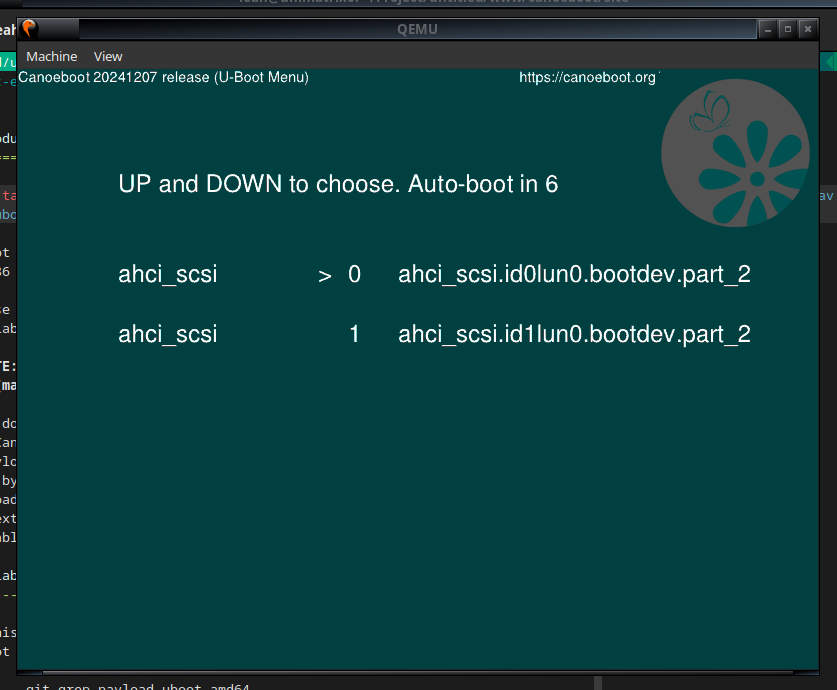
Not every board has it yet. U-Boot is still experimental on x86. Canoeboot has made several modifications to the default bootflow menu, used for selecting an EFI application at boot (e.g. installed GRUB bootloader for distro. For example, upstream didn’t implement an auto-boot timeout for the first selected boot item, so this was implemented. Canoeboot also themed it to look more like an official Canoeboot bootloader.
Here is an example of what it looks like on the boot menu:
https://mas.to/@libreleah/113596262378713418
Errors
If you see error -25 in the bootflow menu, it’s because there’s nothing installed that i t can use e.g. EFI bootloader such as GRUB.
If you see error -2 it’s likely that you have tried to boot a USB drive automatically; sometimes you have to do it manually (see the section below about using the bootflow command manually, via bootflow select).
Boot OS installer (USB)
Just stick your formatted USB stick in. U-Boot should detect it. Sometimes some USB flash drives are broken, because many of them violate specifications and U-Boot doesn’t properly hack around that like Linux does (buggy USB mass storage implementation) - also, xhci suppport is still a bit unstable, on machines that don’t have EHCI controllers (e.g. Haswell setups and beyond).
If your USB drive is detected at boot, a menu might appear, showing it and you can select it, sometimes it doesn’t and you could instead do in the U-Boot shell:
bootflow list
bootflow select X
Where X is the number of the boot device, as shown by the output of the list command.
After selecting the device, you can do:
bootflow bootBooting installed system
It should just work. If all is well, it’ll show the bootflow menu. Simply select your device. If you see error, perhaps try:
bootefi bootmgrSecureBoot
Supported by U-Boot, though U-Boot does not currently have a robust way of storing EFI variables, and Canoeboot disables SecureBoot by default. However, you can enable it. Information is available in U-Boot’s official documentation.
If you want real boot security, don’t use UEFI. Canoeboot’s GRUB payload can be heavily hardened, by following the GRUB hardening guide; this means using the GRUB payload instead of U-Boot.
UEFI SecureBoot with a Linux UKI could achieve similar results in a security sense to Canoeboot’s GRUB hardening setup, though the latter is more flexible, albeit not widely used by the mainstream, but it does work (I use it myself!).
ThinkPad X60/T60
The 32-bit U-Boot payload is only useful for 32-bit setups, and 32-bit UEFI isn’t really that common on x86; the 64-bit U-Boot payload is much more useful, in this context.
Most ThinkPad X60/T60 have 32-bit-only CPUs in them, so the 32-bit U-Boot payload is used. If you have a 64-bit CPU (Core 2 Duo instead of Core Duo), namely Core 2 Duo L9400, T5600 or T7200, you might be able to use the 64-bit payload instead, for full 64-bit UEFI, but this is currently not tested and it is not configured.
To enable this, on compatible CPUs, make the following modifications to the build system and compile a custom image:
Check config/coreboot/x60/target.cfg (change x60 to what you use if it differs), and you’ll find something like this:
build_depend="seabios/default grub/default u-boot/i386coreboot"
payload_uboot_i386="y"
In the above example, you would change it to:
build_depend="seabios/default grub/default u-boot/amd64coreboot"
payload_uboot_amd64="y"
You can then re-compile the image, using standard build instructions. For example on X60 you would use the following build target:
./mk -b coreboot x60Using a full UEFI setup on such old hardware is quite novel and might be interesting in the future, as more distros stop supporting BIOS-based methods, or where the latter may become untested in the future.
Bugs
Limited testing, at least as of 5 December 2024, but some issues that appeared included:
- Haswell: USB support very flaky. E.g. some keyboards work, some don’t, some USB drives work, some don’t.
- ThinkPad T480: U-Boot simply boot loops endlessly, but sometimes boots and shows a menu: SATA doesn’t work, but NVMe SSDs do, and you can boot just fine, but you might not be able to boot with the bootflow menu; the
booteficommand can be used. - Certain ivybridge laptops eg. Dell Latitude: EFI framebuffer got completely b0rked.
The good news is that a few systems were tested that seemed to work well. Haswell machines mostly work OK (with a few bugs), some Kaby Lake machines work but some don’t very well; the GM45 machines work well, e.g. a ThinkPad X200 was tested.
Mitigating instability
U-Boot is not a primary payload on any board where it’s enabled. It’s instead chainloaded from SeaBIOS on 64-bit x86, and from GRUB on 32-bit x86. You select it in the SeaBIOS menu (ESC menu), or you can use a ROM image that has seauboot in the name, where SeaBIOS auto-boots U-Boot unless interrupted via the ESC prompt.
So if U-Boot is unstable on your board, you can press ESC in SeaBIOS and boot a device in SeaBIOS, or select the available GRUB payload from SeaBIOS.
Please do report any failures or successes with your testing, if you want to try out U-Boot.
TODO: A lot more documentation and testing notes should be written here over time, and lots more bug fixes are needed for U-Boot to become stable. It is the intention of Canoeboot that U-Boot become the DEFAULT payload on x86 in a future release.
Markdown file for this page: https://canoeboot.org/docs/uboot/uboot-x86.md
This HTML page was generated by the Canoeboot Static Site Generator.